

Статья
Вальтер Уокер: Я из Бразилии, но сделан в России
1 января 2026

'%3e%3cpath%20fill-rule='evenodd'%20clip-rule='evenodd'%20d='M0%2040H10.6658L10.9549%2016.8571L15.9984%2023.5714C18.7724%2027.264%2021.2973%2030.2743%2021.6094%2030.2606C21.9215%2030.2463%2024.3412%2027.2943%2026.9864%2023.7L31.7959%2017.1646L32.085%2040H43.2851V0L32.8646%200.0205714L27.2536%207.43885C22.978%2013.092%2021.5154%2014.6754%2021.1082%2014.0937C20.8143%2013.6737%2018.3027%2010.3308%2015.5271%206.66513L10.4803%200H0V40ZM47.0258%2040H57.6919L57.981%2016.9126L62.9721%2023.5989C65.7178%2027.2766%2068.1786%2030.2857%2068.441%2030.2857C68.7034%2030.2857%2071.1466%2027.308%2073.8698%2023.6691L78.8219%2017.0526L79.111%2040H101.859L106.076%2028.8571H119.903L124.098%2040H135.721L134.361%2036.7143C133.613%2034.9069%20129.949%2025.9137%20126.219%2016.7291L119.435%200.0291429L106.601%200L90.5784%2039.1091L90.2973%200H79.7502L78.4174%201.85714C77.6848%202.87829%2075.1646%206.20799%2072.8176%209.25656L68.55%2014.7983L57.4466%200.0182857L47.0258%200V40ZM139.475%209.71428H151.765V40H162.987V9.67885L176.013%209.99999L188.038%2039.7143H196.894L203.458%2022C207.068%2012.2571%20210.378%203.32172%20210.814%202.14286L211.608%200L200.662%200.0114286L196.712%2010.72C194.539%2016.6097%20192.588%2021.6377%20192.375%2021.8937C192.163%2022.1491%20190.135%2017.328%20187.869%2011.1794L183.75%200H139.475V9.71428ZM114.984%2015.576C115.814%2017.852%20116.493%2019.9068%20116.494%2020.1428C116.495%2020.3788%20114.933%2020.5714%20113.023%2020.5714C111.112%2020.5714%20109.547%2020.3788%20109.546%2020.1428C109.544%2019.9068%20110.297%2017.7114%20111.218%2015.2634C112.139%2012.816%20113.024%2010.9531%20113.184%2011.1251C113.345%2011.2966%20114.154%2013.2994%20114.984%2015.576ZM131.459%2020.7783C131.459%2020.892%20132.182%2022.692%20133.067%2024.7783L134.676%2028.5714H145.887V20.5714H138.673C134.705%2020.5714%20131.459%2020.6646%20131.459%2020.7783Z'%20fill='%23ED1C24'/%3e%3cpath%20d='M203.233%2039.9999L206.26%2031.9086H214.871L211.844%2039.9999H203.233Z'%20fill='%23ED1C24'/%3e%3cpath%20d='M206.641%2029.4889L209.553%2021.1606H213.141L212.085%2024.4306H211.465C210.774%2024.4306%20210.551%2025.4477%20211.078%2025.7525C211.349%2025.7663%20212.077%2025.9867%20213.251%2025.9536C214.374%2025.9221%20213.924%2024.615%20213.51%2024.5492L214.564%2021.1606H218.222L215.309%2029.4889H206.641Z'%20fill='%23ED1C24'/%3e%3cpath%20d='M224.806%203.9825L225.813%200.752319H216.85L216.126%203.47629L217.576%205.44676L214.053%208.61356L213.69%2010.4433H222.049L223.036%207.38202H219.976L222.049%205.44676L220.733%203.9825H224.806Z'%20fill='%23ED1C24'/%3e%3cpath%20fill-rule='evenodd'%20clip-rule='evenodd'%20d='M213.024%2011.5321L210.314%2019.2333H218.978L221.831%2011.5321H213.024ZM214.753%2014.5439L214.415%2015.8402H217.389L217.857%2014.6255L214.753%2014.5439Z'%20fill='%23ED1C24'/%3e%3c/g%3e%3cdefs%3e%3cclipPath%20id='clip0_3911_2007'%3e%3crect%20width='226'%20height='40'%20fill='white'/%3e%3c/clipPath%3e%3c/defs%3e%3c/svg%3e)

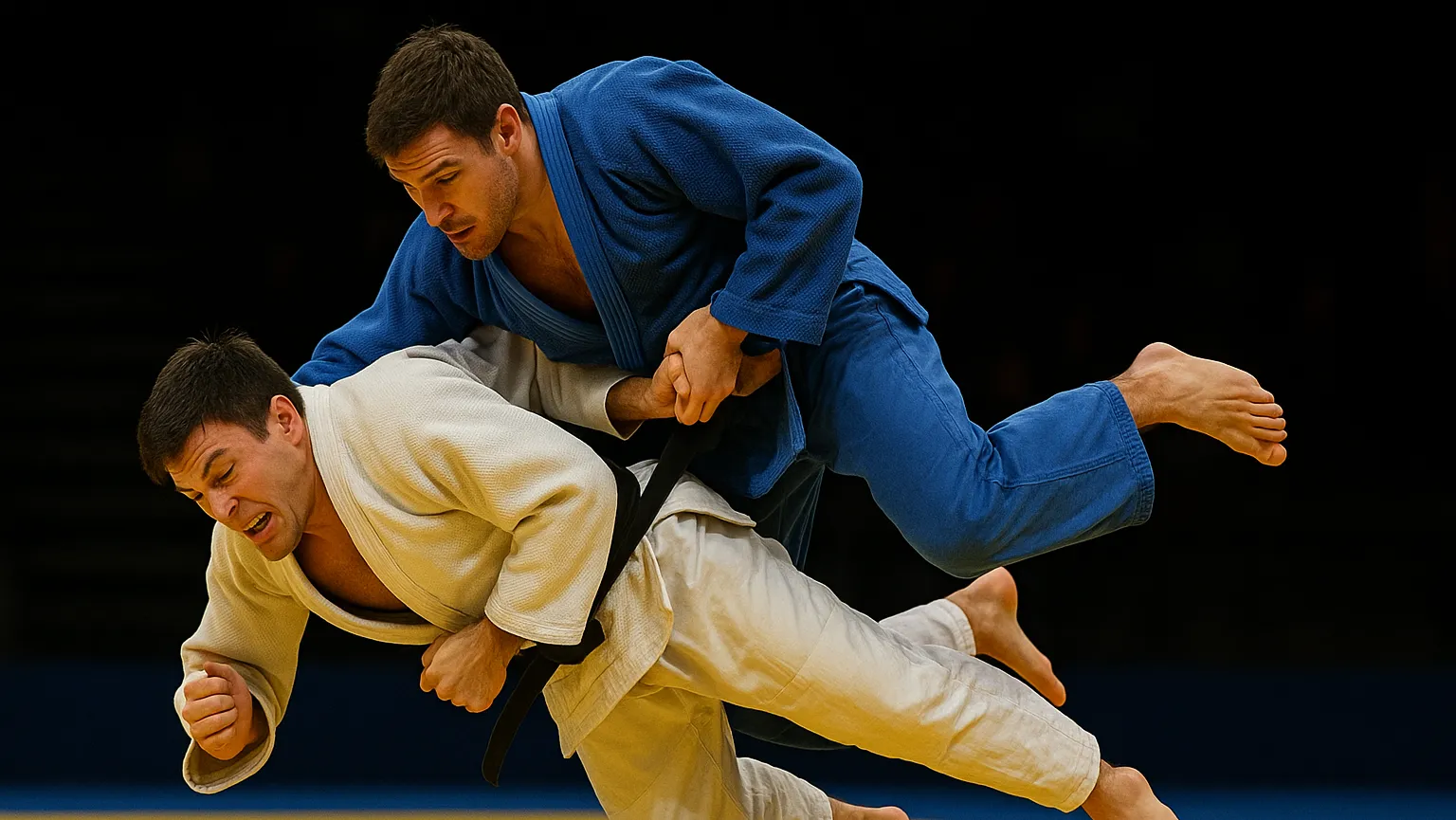
Дзюдо — японское боевое искусство, в котором основное внимание уделяется броскам, удержаниям, болевым и удушающим приёмам. В отличие от дугих видов борьбы, упор делается не на силу, а на технику. Бойцы, пришедшие в ММА из дзюдо, доказали, что классические единоборства могут быть адаптированы к жестким условиям боя.
Одной из самых ярких фигур можно назвать Ронду Раузи – олимпийскую чемпионку по дзюдо, которая прославилась в ММА благодаря своим стремительным болевым замкам и агрессивному стилю боя. Её выступления в смешанных единоборствах показали, как приёмы дзюдо могут стать мощным оружием в арсенале современных бойцов ММА.
Каро Паризян, известный своим умением использовать бросковые техники для контроля и быстрого завершения поединка, также пришел из дзюдо. Среди приёмов, оказавшихся особенно эффективными в октагоне, можно выделить «сэойнагэ» – бросок через плечо и динамичные переводы в партер, которые позволяют не только доминировать над противником, но и быстро переходить в позицию для болевого или удушающего приема.
Рассмотрим единоборство, приёмы которого стали эффективным оружием в руках опытных бойцов ММА.
История
Дзюдо выросло из традиционного японского боевого искуства дзю-дзюцу, или в более привычном произношении, джиу-джитсу (о нем мы подробно говорили здесь). В 1868—1889 годах Япония переживала период, называемый Реставрацией Мэйдзи. Закрытая до этого времени страна, распахнула двери зарубежным новшествам, в основном западным. Традиционные ценности начали забываться, в том числе боевые искусства. В этот момент появился Дзигиро Кано.
В детстве Дзигиро был слабым ребенком, чтобы над ним не издевались, стал заниматься джиу-джитсу, учился у мастеров разных школ и в возрасте 22 лет открыл собственную школу единоборств. Он назвал её Дзюдо Кодокан – «мягкий», или «гибкий путь». Своей задачей он провозгласил добиться объединения ума и тела учеников. С одной стороны, Кано был очень строг к своим студентам, требовал железной дисциплины, с другой – позволял заниматься без оплаты, за символические рис и чай, сам шил ребятам кимоно для тренировок.
Новое боевое искусство дало впечатляющие результаты на соревнованиях 1885-1888 годов. Ученики Кано выиграли у представителей других школ. Дзюдо начало распространяться по Японии, а в 1907 году стало обязательным предметом в общеобразовательных школах.
В 1964 году, во время Олимпиады в Токио, творение Кано вошло в семью Олимпийских видов спорта.
Дзигиро был не только хорошим мастером боевых искусств, но и успешным промоутером. Уделял много внимания популяризации дзюдо: посылал своих учеников проводить показательные бои зарубежом. В 1903 году ученик Кано Ёсиаки Ямасита провёл демонстрацию дзюдо для президента США Теодора Рузвельта. Другие евангелисты единоборства поехали с показами по Северной и Южной Америке, открывали школы в Англии, Индии и других странах. Мицуё Маэда стал основоположником бразильского джиу-джитсу, а Василий Сергеевич Ощепков создал в СССР один из самых знаменитых национальных видов спорта – самбо (о нем мы подробно говорили здесь).
Правила дзюдо
Правила зависят от организации, проводящей турнир и могут незначительно отличаться. Рассмотрим ключевые аспекты. Действие происходит на татами размером от 8х8 до 10х10 м. Борцы используют техники бросков, борьбы лежа, болевые и удушающие приемы, а также захваты и удержания. Перед и после поединка соперники должны друг другу поклониться.
Весовые категории
В дзюдо семь весовых категорий:
| Мужчины Вес в килограммах |
Женщины Вес в килограммах |
| До 60 | До 48 |
| 60 - 66 | 48 - 52 |
| 66 - 73 | 52 - 57 |
| 73 - 81 | 57 - 63 |
| 81 - 90 | 63 - 70 |
| 90 - 100 | 70 - 78 |
| Свыше 100 | Свыше 78 |
| Абсолютная | Абсолютная |
Экипировка в дзюдо
Участники соревнуются в дзюдогах (кимоно) белого и синего цвета. Они должны быть опрятны, не порваны, куртка должна закрывать ягодицы на 5 см. Когда руки разведены на уровне плеч, рукава должны провисать не менее, чем на 10 см. Брюки – быть не выше 5 см от лодыжки. Кимоно подвязывается поясом, соответствующим статусу дзюдоиста. Пояс дважды обвивается вокруг куртки.
Женщины обязаны надевать под кимоно футболку или трико белого цвета с круглым вырезом и коротким рукавом.
Если дзюдога не соответствует правилам, спортсмен дисквалифицируется, а победа присуждается его сопернику.
Дзюдоисты выступают босиком, какая-либо защита не используется.
Пояса в дзюдо
В дзюдо шесть ученических степеней (кю) и десять мастерских (дан). Для получения новой степени нужно сдать экзамен, а также выполнить требования по возрасту и времени занятий дзюдо.
Пояса и квалификации:
Тайминг в дзюдо
Продолжительность схватки в дзюдо для спортсменов с 18 лет – 4 минуты. Время дополнительного раунда в случае ничьей – не ограничено. В этом случае поединок выигрывает первый сделавший оцениваемое техническое действие, либо тот, чей противник первым получил штрафное очко.
Запрещёные приемы в дзюдо
В дзюдо запрещены:
При совершении трех незначительных нарушений, спортсмену объявляется дисквалификация. Если борец делает серьезное нарушение, то получает дисквалификацию сразу.
Судейство
Матч судят:
Рефери оценивает:
Определение победителя в дзюдо
В этом единоборстве не допустима ничья.
Чистая победа (иппон) присуждается если:
Половина победы (ваза-ари) дается если:
Если участник в течение поединка получает две ваза-ари, он объявляется победителем.
Полные правила дзюдо можно прочитать здесь.
Знаменитые дзюдоисты
Создатель крутых боевиков, перестрелок и эффектных драк на киноэкранах – режиссёр Гай Ричи имеет черный пояс по дзюдо.
Этим боевым искусством занимались и российские звезды: брутальный Дмитрий Нагиев в одном из интервью сказал, что «мужской стержень» в нем сформировался в зале единоборств. У Дмитрия первый взрослый разряд по дзюдо. Другой персонаж фильмов про сильных мужчин Дмитрий Певцов в детстве тоже занимался дзюдо.
Но, пожалуй, самым ярким представителем братства успешных дзюдоистов можно назвать Владимира Путина. В 23 год он выиграл чемпионат Ленинграда и стал мастером спорта по этому единоборству. Его коронные приемы – бросок через спину с колен и бросок с захватом двух рукавов долго наводили ужас на соперников. Президент продолжает заниматься дзюдо по сей день. На данный момент у него восьмой дан и звание заслуженного тренера России.
Дзюдоисты в ММА
В поединке Ронды Раузи против Мейши Тейт на UFC 168, Роузи эффектно применила классическую дзюдо-технику: выполнила бросок и моментально перешла к болевому замку на руку, что привело чемпионку мира по дзюдо к быстрой победе.
Каро Паризян, чемпион США по дзюдо, также неоднократно демонстрировал эффективность своих техник в UFC. В боях он часто использовал бросок через плечо, после чего устанавливал контроль в партере и готовил почву для дальнейших болевых приёмов.
Среди бойцов ММА Серии также есть успешные дзюдоисты. Топовый тяжеловес Димитрий Андрюшко – кандидат в мастера спорта по этому единоборству. Хасбулат Хасанов, выступавший на дуэли с Ильей Харитоновым – тоже кандидат в мастера спорта по дзюдо.
